Moon's Hidden Side

Santosh Jha
| 24-03-2026
 · Travel team
For centuries, humans gazed at the Moon and believed they knew it well.
Its familiar patterns lit the night sky, appearing constant and unchanging.
Yet, half of the Moon remained completely unseen — a hidden world that no human eye had witnessed until the space age. This mysterious region, often misunderstood as the “dark side,” is not permanently shadowed but simply turned away from Earth, revealing one of the most fascinating dynamics in planetary science.
Why the Hidden Side Exists
The reason we never see the Moon's far side lies in a phenomenon known as tidal locking. The Moon rotates on its axis at exactly the same rate that it orbits Earth. As a result, the same hemisphere always faces us.
This synchronization developed over millions of years due to gravitational interaction. The gravitational pull between Earth and the Moon gradually slowed the Moon's rotation until it matched its orbital period.
Contrary to popular belief, the far side is not permanently dark. It receives sunlight just like the near side; it simply remains out of view from Earth-based observers.
What the Hidden Side Looks Like
When spacecraft finally revealed the far side, scientists discovered a landscape very different from the familiar face of the Moon.
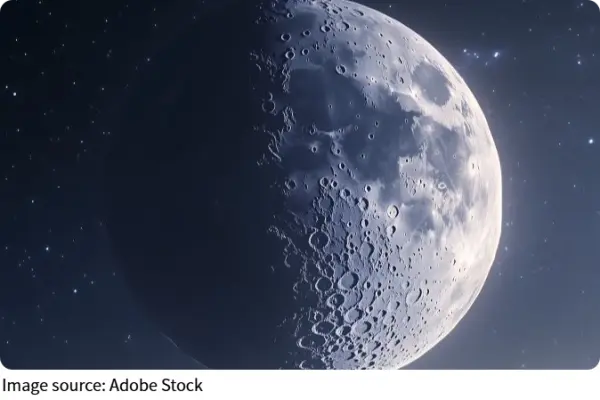
1. Heavily cratered terrain – The far side contains significantly more impact craters, indicating an older and less geologically active surface.
2. Thicker crust – Geological studies suggest the crust on the far side is thicker, which limited volcanic activity.
3. Fewer dark plains – The smooth, darker regions seen on the near side are rare on the far side, giving it a brighter and rougher appearance.
These differences highlight how unevenly the Moon evolved, offering clues about its early formation.
Key Missions That Revealed It
The hidden side remained completely unknown until the mid-20th century, when space exploration changed everything.
1. Luna 3 (1959) – The first spacecraft to photograph the far side, providing humanity's first glimpse of this unseen region.
2. Apollo 8 (1968) – Astronauts became the first humans to directly observe the far side while orbiting the Moon.
3. Modern orbital missions – Spacecraft equipped with advanced imaging systems have mapped the far side in high detail, revealing its composition and structure.
These missions transformed the far side from a mystery into a well-documented scientific frontier.
Scientific Importance Today
The far side of the Moon is more than a curiosity — it plays a key role in modern research. Because it is shielded from Earth's radio signals, it is considered one of the quietest locations in the inner solar system for radio astronomy.
Scientists such as Dr. Paul Spudis, a noted lunar geologist whose work helped map and interpret impact features on the Moon, and Dr. David C. Slater, a planetary scientist who developed instruments for studying craters from orbit, also study its ancient surface to better understand the early history of the Moon and the solar system. Their research shows how the abundance of craters acts like a preserved record of cosmic impacts over billions of years, offering clues to planetary evolution.
A Different Perspective on the Moon
The discovery of the Moon's hidden side changed how we perceive our closest celestial neighbor. What once seemed like a simple, familiar object turned out to be far more complex and asymmetrical than expected.
This unseen hemisphere reminds us that even the most familiar objects can hold profound mysteries. As technology advances and exploration continues, the far side of the Moon stands as a symbol of curiosity — a quiet, distant landscape that invites us to keep looking beyond what is immediately visible.