Replace Your Tires

Yuna
| 12-05-2026
 · Automobile team
Tires don't give a lot of warning before things go wrong.
One day they're working fine, and the next you're dealing with a flat or, worse, a blowout on the highway. The good news is that with a few basic checks, you can stay well ahead of the problem.
How to Measure Tread Depth
Tread depth is the number one thing to watch. A good depth is 6/32" or deeper, and anything at 2/32" or lower is legally below the minimum in most states — and genuinely unsafe on wet roads. An easy way to test this without any special tools is the quarter test. Insert a quarter into a tread groove with the head side facing downward.
If the top of his head disappears into the tread, you've got at least 4/32" left — fine for now. If you can see his entire head, start shopping for new tires soon. The penny test works the same way — if the head is fully visible, you're at or below the legal minimum. AAA actually recommends the quarter test over the penny test because by the time you fail the penny test, your tires are already in dangerous territory.
Warning Signs While Driving
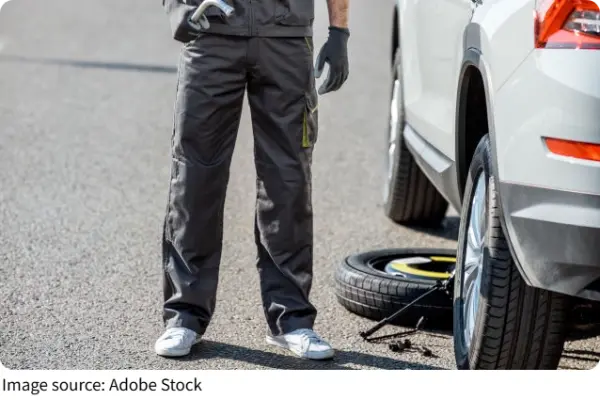
Pay attention to how the car feels. Unusual vibrations or thumping sounds can mean an out-of-balance tire or a separated belt inside the rubber — neither is something to ignore. If the car pulls to one side at a steady speed, it could be an underinflated or damaged tire on that side, or an alignment issue. These aren't just annoyances; they're your tires communicating that something's off.
What to Look for During Inspection
Walk around the car and actually look at each tire, not just glance at it. Uneven wear along one edge of the tread usually points to an alignment or suspension problem. "Cupping" or alternating high-and-low spots around the tread often indicates worn shock absorbers.
On the sidewall, look for cuts, tears, or any kind of bubble or bulge. A bubble means a belt inside the tire has separated — replace that tire immediately. Don't wait. A sidewall bubble can fail at any moment, and there's no patching it.
Age and Rotation
Even tires that look decent have a time limit. Most manufacturers recommend replacing tires every six years regardless of how much tread remains, because rubber breaks down over time from heat and UV exposure. Rotating your tires every 5,000 to 8,000 miles helps them wear evenly and extends their life. Tires that are never rotated develop uneven wear patterns that shorten their usable lifespan significantly.
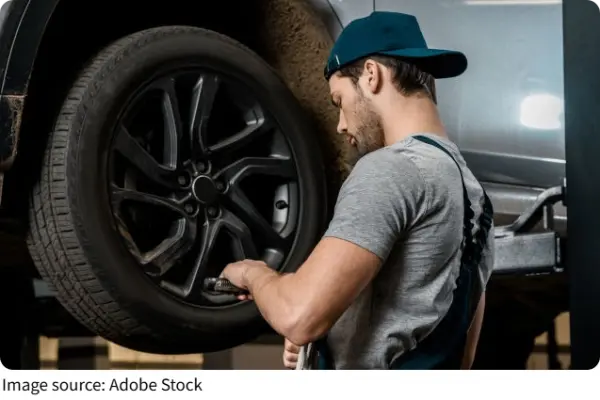
Tire pressure also matters beyond just safety — underinflated tires reduce fuel efficiency and wear out the outer edges faster, while overinflated tires concentrate wear in the center. Check pressure monthly with a gauge and compare it to the sticker on your door frame.