Wild Facts About Earth

Mariana Silva
| 01-06-2026
 · Science team
Earth is often taken for granted as the familiar ground beneath our feet, but in reality, it is a remarkably complex and dynamic planet.
From its imperfect shape and extreme internal structure to its vast oceans and constant motion through space, Earth is filled with natural phenomena that are both fascinating and scientifically profound. This article explores some of the most surprising and lesser-known facts that reveal just how extraordinary our home planet truly is.
Earth Is Not a Perfect Sphere
Earth is not a perfectly round sphere. Due to its rotation, the planet is slightly flattened at the poles and bulges at the equator. This shape, known as an oblate spheroid, also contributes to small variations in gravitational strength across different locations on Earth.
As a result, a person’s weight can be slightly lower at the equator compared to the poles, though the difference is subtle.

Earth’s Interior Is Extremely Hot
Beneath Earth’s surface lies a layered structure consisting of the crust, mantle, outer core, and inner core. The inner core is a solid sphere composed primarily of iron and nickel, with an estimated radius of about 760 miles (1,220 km). Temperatures in this region reach approximately 9,800°F (5,400°C).
Above the core is the mantle, a layer roughly 1,800 miles (2,900 km) thick. Although often described as molten, the mantle is predominantly solid rock that flows very slowly over geological time due to extreme heat and pressure. These internal processes play a key role in shaping Earth’s surface through plate tectonics.
The Ocean Dominates Earth’s Surface
Approximately 71% of Earth’s surface is covered by oceans, which contain about 97% of the planet’s water. The average ocean depth is around 2.3 miles (3.7 km).
The deepest known point is the Mariana Trench in the Pacific Ocean, reaching depths of about 36,000 feet (10,900+ meters). Despite technological advances, only about 25% of the ocean floor has been mapped in high resolution, meaning much of Earth’s underwater landscape remains unexplored.
Earth Is Constantly Moving Through Space
Earth is in continuous motion. It orbits the Sun at an average speed of approximately 67,000 miles per hour (107,000 km/h).
In addition, Earth rotates on its axis at speeds of up to about 1,000 miles per hour (1,600 km/h) at the equator. These simultaneous motions occur without any physical sensation, making them easy to overlook in daily life.
Forests Are Connected Through Underground Networks
Trees are interconnected through underground fungal networks known as mycorrhizal systems. These networks facilitate the exchange of nutrients and chemical signals between plants and are sometimes referred to as the “Wood Wide Web.”
This underground system contributes to forest resilience by allowing trees to respond collectively to environmental stress, disease, and changes in their surroundings.
Complex Life Is Relatively Recent
For most of Earth’s history, the planet was dominated by single-celled organisms such as bacteria. Complex multicellular life, including animals, emerged much later in geological time.
When viewed on a geological timescale, humans and other animals represent a relatively small portion of Earth’s biological history.
Lightning Is a Constant Global Phenomenon
Lightning occurs continuously around the world, with an estimated 8 to 9 million lightning strikes striking Earth each day.
Additionally, sunlight takes approximately eight minutes to reach Earth’s surface, meaning the light we see is not instantaneous but a delayed reflection of the Sun’s energy.
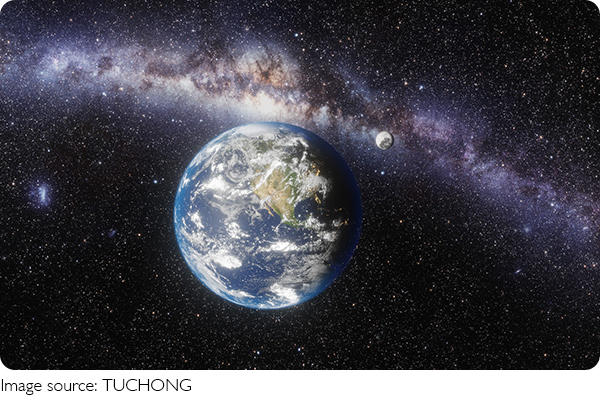
Earth is a dynamic and evolving system shaped by physical forces, biological processes, and cosmic motion. Its internal structure, oceans, atmosphere, and ecosystems all interact in complex ways that sustain life and drive continuous change. Understanding these characteristics provides a deeper appreciation of Earth not just as a habitat, but as an active and intricate planetary system.