Rotate Tires, Save Money

Nora
| 29-06-2026
 · Automobile team
Tires are one of the most expensive parts of owning a car. A decent set runs from a few hundred dollars to well over a thousand, depending on the vehicle.
So anything that extends their usable life is worth doing — and tire rotation is one of the most effective and most overlooked of these habits.
Why Tires Wear Unevenly in the First Place
Every car puts different demands on different tires. On a front-wheel-drive car, the front tires handle steering, acceleration, and a large share of braking — so they wear significantly faster than the rears, which are mostly just rolling along. On a rear-wheel-drive vehicle, the situation reverses. Even on all-wheel-drive cars, weight distribution and drivetrain forces cause uneven wear patterns across all four.
Left unchecked, this means two tires wear out well before the other two. The owner ends up buying just two new tires, which then sit alongside two older, worn tires with different traction characteristics — not ideal for handling or safety.
The Fix Is Simple Rotation
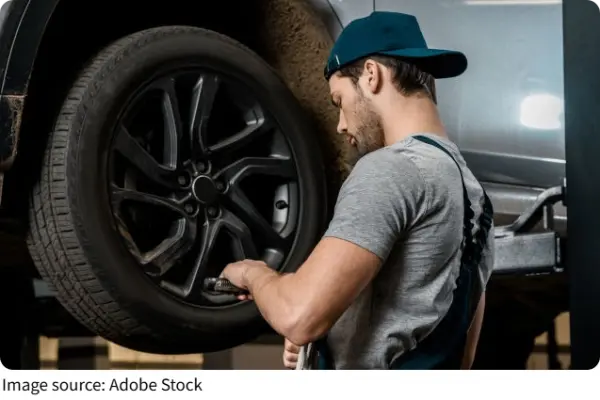
Moving the tires to different positions periodically evens out the wear across all four, so they all reach the end of their life at roughly the same time. Most tire manufacturers recommend rotating every 5,000 to 8,000 miles. Conveniently, this often lines up with oil change intervals, which makes it easy to bundle both services together.
The most common rotation pattern for front-wheel-drive cars is to move the front tires straight to the rear and cross the rear tires to the front. Rear-wheel-drive cars typically do the opposite. All-wheel-drive cars generally use an X-pattern, crossing all four. Your owner's manual specifies the correct pattern for your vehicle.
What to Check During a Rotation
When the wheels are off, it's a good opportunity to inspect the tires more closely. Look at the tread depth. Most tires have built-in wear indicators — small rubber nubs in the grooves that become flush with the tread surface when the tire is worn down. If those are flush, it's time for new tires.
Also check the wear pattern. Even wear across the tread means the tire pressure and alignment are correct. Wear concentrated in the center of the tread suggests over-inflation. Wear on both edges but not the center means under-inflation. Wear on just one edge means an alignment issue that needs attention before new tires are installed — otherwise the same uneven wear pattern will destroy the new tires just as quickly.

Most Shops Do It for Free or Close to It
Many dealerships and tire shops include rotation in oil change packages at little or no extra charge. If you're buying a new set of tires, ask about lifetime free rotation — many retailers offer it as a standard benefit. Over the life of a set of tires, that can save a meaningful amount of money and significantly delay having to buy the next set.