France's Final Frontier

Mason O'Donnell
| 27-09-2026
 · Travel team
Hello, Lykkers! When people think of the Alps, Switzerland often steals the spotlight. But on the French side of this legendary mountain range, you'll find something rawer, wilder, and unmistakably French. From the eternal ice of Mont Blanc to the emerald waters of Lake Annecy, here are five places that deserve a spot on your itinerary.
Chamonix: Standing at 3,842 Meters Above Europe
Chamonix is the most famous name in the French Alps. Sitting at the foot of Mont Blanc, it has been the birthplace of European mountaineering since the 18th century and remains a pilgrimage site for climbers worldwide.
The most breathtaking experience here is the Aiguille du Midi cable car, which climbs from town at 1,035 meters to 3,842 meters in about 20 minutes. From the viewing platform, you look down a vertical drop of over 1,000 meters, with Mont Blanc and the peaks of Switzerland and Italy spread before you. Round-trip tickets cost around $43 (prices may vary).
Back in the valley, don't miss the Mer de Glace, France's largest glacier. The famous red mountain train takes you to the glacier's edge, where a cave carved into the ice lets you step inside and see its remarkable blue tones. The full Mer de Glace Voyage ticket, including train, gondola, and ice cave access, is roughly $54 (prices may vary). For skiers, a one-day Chamonix Le Pass ranges from about $51 to $64 (prices may vary).
Annecy: The "Venice of the Alps"
About an hour's drive from Chamonix, you enter a completely different world. Annecy regularly appears on lists of France's most beautiful towns, and its old quarter—laced with canals, stone bridges, and pastel houses reflected in the water—earns its nickname, the "Venice of the Alps."
The town's most photographed landmark is the Palais de l'Île, a 12th-century triangular stone fortress built in the middle of a canal. Once a prison, it now stands as Annecy's icon. Above the old town, Annecy Castle offers the best panoramic views of the lake and mountains.
Lake Annecy itself is one of Europe's cleanest lakes, its water an almost unreal shade of turquoise. A flat cycling path runs along the shore, and renting a bike for an afternoon is one of the most pleasant ways to spend a summer day. Double rooms in central Annecy typically range from around $100 to $490 per night depending on the season and property (prices may vary).
Annecy
Saint-Gervais-les-Bains: The Alps' New Star for 2026
Tucked between Chamonix and Megève, Saint-Gervais-les-Bains has long been overlooked by visitors. That changed in 2026, when Condé Nast Traveller named it one of the best destinations in the world.
The reasons are compelling. The century-old Mont Blanc tramway introduced a new generation of low-energy trains in summer 2026. Even more exciting is Le Valléen cable car, which whisks you from the main train station to the mountain resort center in just five minutes—the first cable car system in France to connect a main railway station directly to a mountain resort.
Saint-Gervais is also a historic spa town, with thermal springs discovered in 1806 still in operation today. In winter, it connects to the 450-kilometer Evasion Mont-Blanc ski area; in summer, it's a superb base for hiking and cycling. Hotel prices start around $110 per night and average roughly $200 to $280 for mid-range options (prices may vary).
Saint-Gervais-les-Bains
Bonneval-sur-Arc: The Highest Stone Village
If you want to see what a real Alpine village looks like, Bonneval-sur-Arc is the answer. Located deep in the Maurienne Valley, it sits between 1,800 and 3,638 meters and is officially classified as one of France's most beautiful villages.
The houses here are built of stone, with heavy slate roofs and walls averaging 80 centimeters thick to withstand the long, harsh winters. Curiously, the houses have no street numbers—each one is known by its name instead.
What makes Bonneval special is that it's both a living village and a ski destination. In winter, it connects to a vast ski area; in summer, traditional crafts like woodcarving, pottery, and weaving continue, with villagers selling their work along the roadside.
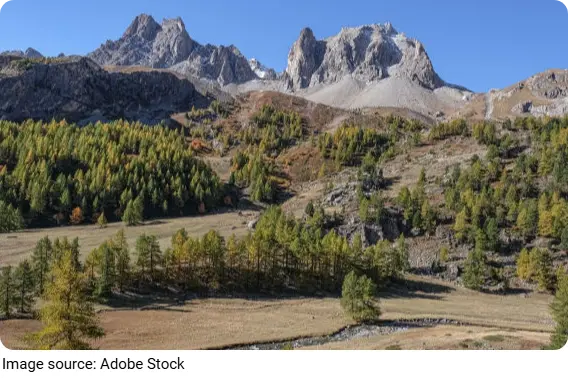
Vanoise National Park: France's Oldest Protected Area
In 1963, Vanoise became France's first national park. It borders Italy's Gran Paradiso National Park, and together they form the largest Alpine protected area in Western Europe.
There's none of Chamonix's bustle here. Ibex and chamois roam freely, the hiking trails are superb, and the crowds are a fraction of what you'll find elsewhere. If you're looking for true tranquility in the Alps, Vanoise is the place.
The small towns of Pralognan-la-Vanoise and Champagny-en-Vanoise, on the park's edge, are the most convenient gateways. From here, you can choose an easy half-day walk or venture deep into the park for several days.
The beauty of the French Alps is that they never show just one face. Glaciers and lakes, adrenaline and serenity, bustling resorts and quiet stone villages—often separated by nothing more than a single valley. These five places let you see its many expressions, all in one trip.