Paddling Étretat Safely

Arvind Singh
| 28-09-2026
 · Travel team
Greetings, sea paddlers. The chalk arches of Étretat create a striking kayaking route, but the coast deserves a plan built around conditions rather than a fixed sightseeing schedule.
Wind, swell, tide, visibility, and falling chalk can change what is sensible on the water.
First-time visitors gain useful local context from a guided outing, while experienced paddlers still need an operator’s current launch advice. The aim is to view the cliffs from a respectful distance and return with enough time and energy for a safe landing.
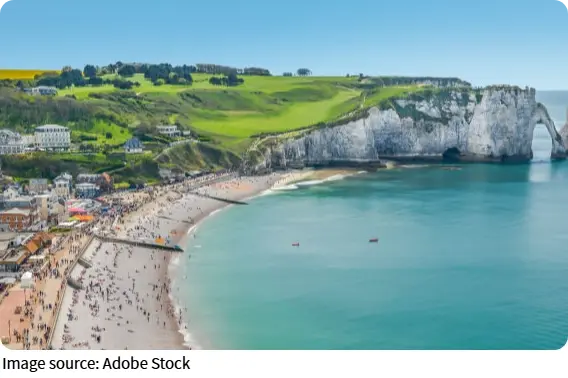
Book the Sea Window
Guided paddle and kayak sessions generally run from early April through late October, subject to weather and sea state. A two-hour session, with at least an hour on the water, has recently cost about US$46 in the quieter period and US$57 from mid-June to mid-September. Equipment is included, while a wetsuit adds about US$5.70. Participants need to swim and meet the operator’s minimum age of 14.
Reserve before building the rest of the day because departures are arranged around conditions and group numbers. Ask which arch is realistic, where the group launches, and what happens if the sea changes. A cancellation is not wasted planning; it is a coastal safety decision.
Keep a flexible walking alternative so cloud or wind does not turn the entire visit into a disappointment. Confirm the arrival time as well, since equipment fitting and a safety briefing occur before the group reaches the water.
Respect the Chalk Edge
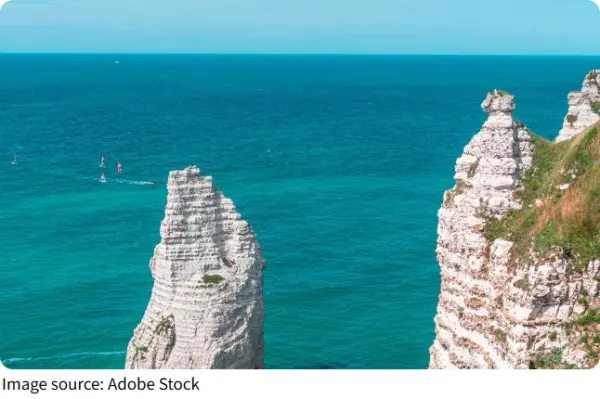
Étretat’s cliffs are active geological formations, and fragments can fall without a useful warning. Stay away from the cliff foot, sea caves, and narrow spaces beneath overhangs unless a qualified guide selects a safe line under current conditions. Do not land beneath the chalk walls. From farther offshore, Porte d’Aval and the Aiguille remain visually strong without requiring a close approach.
Tidal movement can alter beaches, currents, and landing space during one session. Note the forecast, but treat the guide or rental staff’s same-day assessment as decisive. Wear the buoyancy aid provided, keep footwear secured, and attach nothing that could tangle around the body. A waterproof pouch is useful for a small camera, yet hands should remain free whenever balance or steering demands attention.
Aiguille d'Etretat
Choose Guidance or Rental
Independent rental can suit paddlers who understand coastal forecasting and self-rescue. Recent rates were about US$17 for one hour or US$29 for two hours in a single kayak; a double cost about US$34 for one hour or US$57 for two. The local operator pauses rentals when waves exceed roughly half a metre and applies tighter wind limits to beginners, which shows how calm the launch needs to be.
For a first visit, the guided price buys more than equipment. It adds a route choice, group oversight, timing around the tide, and a quicker response if fog or wind arrives. Bring a warm layer for after landing, drinking water, and a change of clothes.
Leave valuables ashore in secure storage, and confirm whether showers or changing space are available before arrival. Prescription glasses need a secure retainer, while a compact towel makes a windy change on shore far more comfortable.
Compare Three Étretat Stays
La Villa 10 has recently been near US$102 per night for two and offers a central base, though breakfast costs extra. Hôtel des Falaises was around US$116 per night for two and places guests close to the beach, a useful advantage for checking the sea before a booked session. Its central position may also mean more street activity during busy periods.
Domaine Saint Clair Le Donjon was roughly US$201 per night for two, with free parking and a hillside setting. It trades immediate beach access for more space around the property and easier car storage. Compare breakfast, parking, cancellation rules, and walking gradients before deciding; the lowest room rate may not produce the lowest complete stay.
Travelers carrying wet gear should also ask where it can dry without disturbing the room. All three figures are planning examples and can change with demand.
Étretat is most enjoyable from a kayak when curiosity remains secondary to sea judgment. Choose a guided window, give the chalk generous space, and let a land-based walk carry the day if the water is not inviting.