Sky Meets Salt

Caroll Alvarado
| 28-09-2026
 · Travel team
Hello, Lykkers! Imagine standing on a surface so flat and white that the sky and earth seem to merge into one.
That's Salar de Uyuni, the world's largest salt flat, sitting at 3,653 meters in Bolivia's Potosí Department. This 10,582-square-kilometer expanse is one of the most surreal landscapes on Earth.
Whether you visit during the rainy season for the famous mirror effect or the dry season for endless hexagonal salt patterns, these six spots will make your journey unforgettable.
1. Isla Incahuasi: A Cactus Forest in the Salt
Rising from the middle of the salt flat is Isla Incahuasi, a rocky island covered in giant cacti that can reach up to 12 meters tall. Some of these cacti are thousands of years old.
Climbing to the top takes about 30 minutes and rewards you with a 360-degree panorama of the endless white salt stretching to the horizon. The island also has restrooms and a small café, making it a convenient stop during a day tour. Entry costs about US$4 per person (prices may vary).
2. Train Cemetery: Rusted Relics of the Past
Just a 15-minute walk from Uyuni town sits the Train Cemetery, where dozens of rusted locomotives and wagons sit abandoned in the desert. These trains date back to the late 19th century when the region was a hub for mineral transport. The site has no entrance fee and is often the first stop on salt flat tours. For photographers, sunset is the best time to visit, when the rusting metal glows against the vast empty landscape.
Train Cemetery
3. The Mirror Effect: A Sky Without Edges
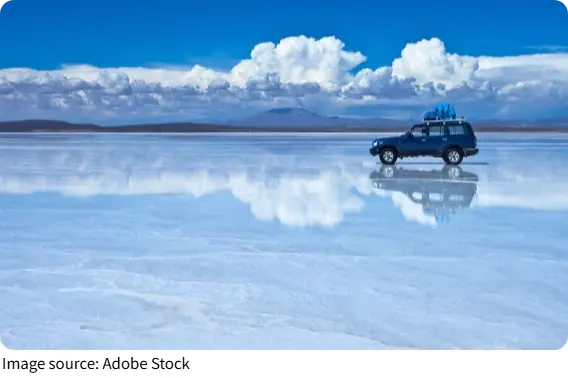
During the rainy season from December to April, a thin layer of water transforms the salt flat into the world's largest natural mirror. The reflection is so perfect that it becomes difficult to tell where the ground ends and the sky begins. This is the experience most travelers dream of. For the best conditions, aim for a clear day with some clouds—too much rain creates bubbles that distort the reflection, while too little water means no mirror at all.
4. Reserva Nacional de Fauna Andina Eduardo Abaroa: Colored Lagoons and Flamingos
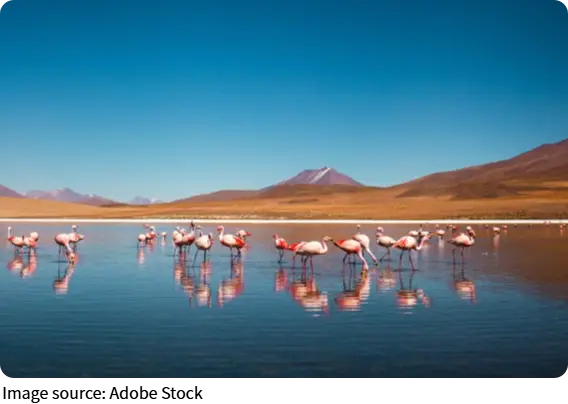
South of the salt flat lies the Eduardo Abaroa Andean Fauna Reserve, a high-altitude wilderness of volcanic rock and mineral-rich lakes. Laguna Colorada glows red from algae and minerals, while Laguna Verde shimmers emerald green at the foot of a volcano. Flamingos wade through the shallows, and vicuñas graze on the sparse grass. Entry to the reserve costs about US$22 per person (prices may vary).
Reserva Nacional de Fauna Andina Eduardo Abaroa
5. Colchani: Where Salt Becomes Art
About 22 kilometers from Uyuni, the small village of Colchani is the unofficial capital of the local salt industry. Here you can watch artisans carve sculptures from blocks of salt, visit a small salt museum, and buy souvenirs made from pink Andean salt. Most tours stop here for about 45 minutes. It's a good place to see how the region's oldest industry still operates today.
6. Stargazing: The Milky Way Without Light Pollution
The Salar de Uyuni sits in one of the lowest light-pollution zones on Earth. On clear nights between May and October, the Milky Way, the Southern Cross, and the Magellanic Clouds are visible to the human eye. Some operators in Colchani offer dedicated star-photography tours that depart after dinner and return around 2 a.m. Even without a camera, lying on the cold salt and watching the sky is an experience that stays with you.
Final Thoughts
Salar de Uyuni is not just a destination—it's a place that changes how you see scale and silence. The salt flat is vast, the altitude is demanding, and the weather can shift quickly. But with the right preparation, these six spots offer a journey that few places on Earth can match. Whether you come for the mirror, the cacti, or the stars, you'll leave with memories that feel almost impossible to describe.