Orangutan Play Dates!

Naveen Kumar
| 21-10-2026
 · Animal team
Young orangutans spend much of their early lives close to their mothers, leaving limited opportunities to meet others of a similar age. Yet play with peers can be an important part of learning social skills.
New research suggests that orangutan mothers do more than simply allow these encounters to happen: they adjust their movements through the forest to help their young find suitable companions, even when doing so requires additional time and energy.
A Different Kind of Parenting
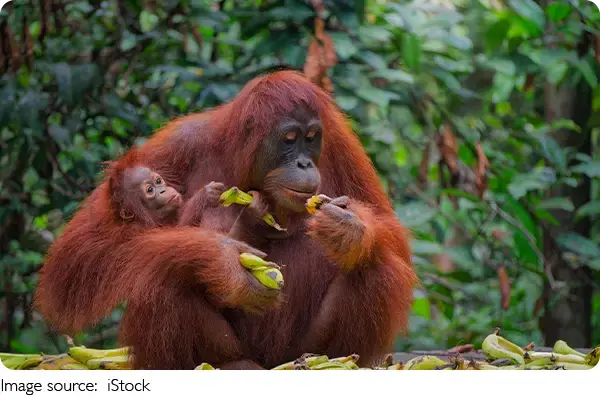
Orangutans are known for their largely solitary way of life. Unlike primates that regularly live in large groups, mothers and their young often spend extended periods together with little direct contact with other families. Young orangutans may remain dependent on their mothers for seven years or longer.
This arrangement creates a challenge. While a mother provides care and helps her offspring learn about its surroundings, opportunities to interact with other young orangutans are relatively limited. Peer play offers a different kind of experience, allowing youngsters to practice coordination, respond to another individual's behavior, and develop social abilities.
A study published in the Proceedings of the National Academy of Sciences provides evidence that mothers help overcome this limitation by adjusting where they travel. The findings suggest that raising offspring involves not only providing food and protection but also creating opportunities for social development.
Years of Watching Forest Families
Researchers built their analysis on long-term observations of wild Bornean orangutans at the Tuanan Research Station in Indonesia. Fieldwork began in 2003, allowing scientists to examine relationships and movement patterns over many years.
The research team eventually assembled approximately 32,000 hours of observations involving 31 mother-and-infant pairs. This extensive record helped investigators examine whether meetings between young orangutans happened by chance or reflected a pattern in their mothers' movements.
To test the idea, researchers compared the locations used by mothers with the ages and social characteristics of nearby families. They also considered other influences, including family relatedness and the availability of fruit.
The analysis revealed that mothers whose offspring were closer in age tended to use more of the same forest areas. Their young also played together more frequently. This pattern remained evident after the researchers accounted for other factors, supporting the idea that mothers' movements help create suitable opportunities for interaction.
How Mothers Arrange Encounters
The findings indicate that these meetings involve more than an accidental crossing of paths. Mothers appeared to move toward the usual areas of neighboring females before opportunities for play occurred. Afterward, they tended to return toward their own familiar areas.
This pattern suggests that mothers may use their knowledge of the forest and its inhabitants to increase the likelihood of encountering families with similarly aged offspring. Their understanding of the surrounding area appears to include more than useful locations for food. It may also include information about where other mothers spend time and when their young might be suitable play partners.
The Cost of Creating Playtime
Arranging these encounters comes with a measurable cost. Mothers traveled farther and spent less time feeding on days associated with play, suggesting that social opportunities require a meaningful investment of energy. However, the meetings were relatively uncommon. Peer play occurred on about 6% of the observation days, equivalent to roughly one day in every 20. When it happened, young orangutans spent approximately 20 minutes playing together in total on that day.
Why Long-Term Research Matters
The study demonstrates the value of observing animals over extended periods. Brief observations might capture young orangutans playing together without revealing the movement patterns that made those meetings possible. Years of records allow researchers to connect individual encounters with broader patterns in family behavior.
The findings also offer a wider lesson about social development. Contact with others does not always happen automatically. In species that spend much of their time alone, creating opportunities for interaction may require considerable effort from caregivers.

Orangutan mothers appear to invest time and energy in helping their young meet suitable playmates, revealing a less visible side of parental care. Whether these efforts provide lasting advantages remains uncertain. Continued observation will help clarify how early play contributes to development and why these encounters matter.