Mysterious Clouds in Space

Chandan Singh
| 29-10-2026
 · Science team
Weather is no longer something scientists can study only within our solar system. Astronomers have confirmed, for the first time, that water clouds on a distant celestial object change in thickness over time.
The discovery was made using the James Webb Space Telescope, which observed WISE 0855, an exceptionally cold brown dwarf located approximately 7.5 light-years from Earth.
The findings, announced in October 2026, reveal a dynamic atmosphere shaped by changing clouds and gases rising from deep inside the object.
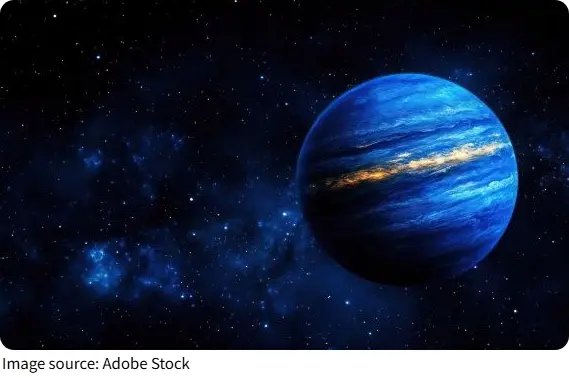
A Strange World Beyond Our Solar System
WISE 0855 belongs to a category of celestial objects known as brown dwarfs.
These unusual bodies occupy the boundary between planets and stars. They form in a similar way to stars but lack sufficient mass to sustain the hydrogen fusion that powers ordinary stars. WISE 0855 is approximately the size of Jupiter, although its mass is roughly twice as great. Its atmospheric temperature is around −8°C, making it the coldest known brown dwarf.
Despite its classification, the object behaves in several ways like a giant planet, making it particularly valuable for studying atmospheric processes beyond our solar system.
How Scientists Detected The Clouds
A research team led by Brittany Miles at the University of Arizona observed WISE 0855 continuously for 11 hours. Using the telescope's spectrograph, scientists collected detailed measurements of its light every 15 minutes. These observations allowed them to identify changes associated with different molecules and atmospheric layers. Previous telescopes could detect variations in brightness, but separating the effects of clouds, temperature and atmospheric chemistry was difficult.
The new measurements provided much greater detail. Researchers confirmed that high-altitude water clouds were becoming thicker and thinner as the brown dwarf rotated.
What Happens Beneath The Clouds?
Changing cloud cover was only part of the discovery. Scientists also detected variations involving carbon monoxide and phosphine. These gases appear to be transported upwards from deeper atmospheric layers through convection. This process occurs when warmer material rises while cooler material sinks, circulating gases through the atmosphere.
Similar atmospheric mixing takes place on Jupiter. By tracking individual molecular signals, researchers could distinguish changes caused by clouds from those associated with gases moving upwards.
Why The Discovery Matters
The observations suggest that some fundamental atmospheric processes operate similarly across very different celestial objects. Although WISE 0855 is not technically a planet, its changing clouds and atmospheric circulation resemble processes found on giant planets. This provides valuable information for researchers investigating distant worlds orbiting other stars.
Understanding how water clouds affect observed light could also improve the interpretation of future telescope measurements. Importantly, detecting water clouds does not establish that the object has liquid oceans or conditions suitable for life.
What Astronomers Hope To Discover Next
The research, accepted for publication in The Astrophysical Journal, demonstrates the remarkable sensitivity of modern space telescopes. Scientists hope to conduct longer observations to better understand WISE 0855's rotation and atmospheric structure.
Future measurements could reveal how clouds, temperatures and chemical circulation interact over time. The findings suggest that distant worlds may possess complex, constantly changing weather systems.

Although separated from Earth by trillions of kilometres, their atmospheres may follow familiar physical principles, offering astronomers a new way to investigate the remarkable diversity of conditions across the universe.