Marcelis Design Show
Ethan Sullivan
| 18-11-2026
 · Art team
Light can completely alter the appearance of an object or room, depending on how it moves across surfaces, interacts with materials and reflects its surroundings. Dutch-New Zealand designer Sabine Marcelis has spent much of her career investigating these possibilities.
Her first museum exhibition, Light and Color, brings together 15 years of creative work at the Museum für Gestaltung Zürich in Switzerland, offering visitors a closer look at her distinctive approach to design.
A Designer Working Across Materials
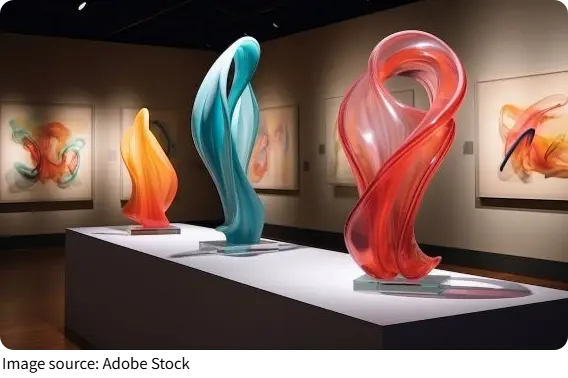
Born in 1985, Marcelis grew up in New Zealand before studying at the Design Academy Eindhoven in the Netherlands, where she graduated in 2011. She later established her design studio in Rotterdam in 2014. Her work connects product design, art and architecture. She creates furniture, lighting objects, mirrors and installations, often using materials that allow light to pass through them or reflect it in unusual ways.
Glass and resin are particularly important to her practice. Their transparency, colour and surface qualities can produce different visual effects depending on lighting conditions. Natural stone is another material she uses to investigate how colour and texture influence the appearance of an object.
Fifteen Years of Creative Work
The Zurich exhibition brings together selected projects from approximately 15 years of Marcelis' practice. Among the earlier works are pieces from the Candy Cube series, which includes colourful furniture made using cast resin. The display also features Tall Stripe and Sunbeam Captured, a project developed with Dutch artist Boris Acket. The latter uses moving water and carefully directed light to recreate the changing appearance of sunlight reflected from a water surface.
These projects demonstrate different ways Marcelis approaches the same subject. Some rely on the colour and transparency of a material, while others use movement and reflection to create effects that extend beyond an individual object.
Installations That Transform Space
Several large installations are among the exhibition's main features. One is a light tunnel developed in collaboration with IKEA Switzerland using products from the VARMBLIXT collection. Its carefully arranged lighting and reflective surfaces create the impression that the space continues beyond its physical boundaries.
Another installation features eight Mathmos Column Lava Lamps positioned in front of mirrored surfaces. Each lamp stands more than 2.5 metres tall, making the arrangement a substantial visual feature. The mirrors multiply the appearance of the illuminated columns, while the slowly moving material inside the lamps introduces a changing element. Instead of presenting lighting as something that simply brightens a room, the installation makes it part of the overall spatial experience.
Showing the Work Behind the Finished Objects
An important part of Light and Color is its attention to the design process. Alongside completed pieces, the exhibition presents material samples, experiments and studies that reveal how ideas develop before becoming finished works. This approach gives visitors a better understanding of the decisions involved in Marcelis' practice. A particular colour or reflective effect may require repeated testing, while the behaviour of glass and resin can introduce technical challenges during production.
Curator Damian Fopp has arranged the exhibition to move between individual objects and larger spatial experiences. This allows visitors to see both the finished results and some of the experimentation that made them possible. The accompanying publication, Sabine Marcelis Making A Show, also documents aspects of the exhibition and its development.
Why Light Remains Central to Her Work
Marcelis' projects demonstrate that light is not simply a finishing detail in design. It can influence the colour of a surface, reveal the qualities of a material or make a familiar room feel completely different. Reflection and transparency also create relationships between objects and their surroundings. A mirror can visually extend a space, while translucent resin can appear brighter or more intense under carefully positioned lighting.
For visitors interested in contemporary design, the exhibition provides an opportunity to consider how light, colour and carefully selected materials can influence the way everyday objects and environments are experienced.