Earth's Tiny New Moon

Marcus
| 27-11-2026
 · Science team
Earth has an unexpected companion this holiday season: a tiny asteroid that has become temporarily trapped by our planet's gravitational pull.
Known as 2026 QQ8, this small space rock is following an orbit around Earth and is expected to remain nearby until January 2027. Although it is far smaller than the Moon, its temporary visit offers astronomers another opportunity to study how objects move through our corner of the solar system.
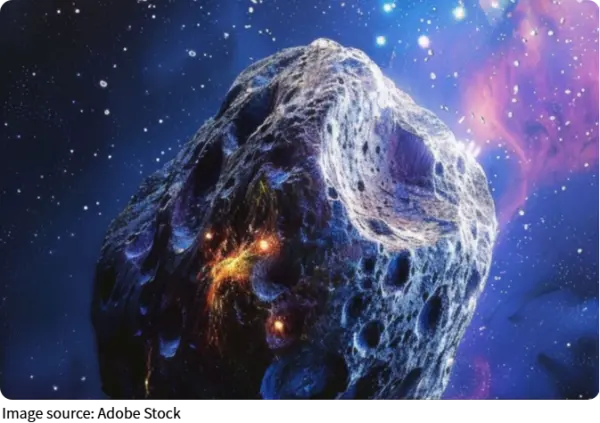
Meet Earth's New Minimoon
Astronomers have confirmed that asteroid 2026 QQ8 became a temporary companion to Earth after entering our planet's orbit in April 2026. Hungarian researcher Krisztián Sárneczky first observed the object in August. Its discovery was subsequently recorded by the International Astronomical Union's Minor Planet Center on October 29, the organisation responsible for documenting newly identified objects in the solar system.
The asteroid measures approximately 6 feet, or 2 metres, across. That makes it extremely small compared with Earth's natural Moon, which has a diameter of about 3,475 kilometres. Despite its modest size, 2026 QQ8 has attracted attention because of its unusual temporary relationship with Earth. Astronomers expect it to remain within our planet's gravitational influence through the holiday period before moving away in January 2027.
Objects like this are commonly called minimoons. They are small space rocks that become temporarily captured by Earth's gravity, allowing them to travel around our planet for a limited period.
Why the Asteroid Will Not Stay Forever
Earth's gravity can influence passing asteroids, occasionally drawing them into temporary orbits. However, these captures are not permanent. The object's movement is also affected by the Sun and other gravitational forces, meaning its path can eventually carry it away from Earth.
For 2026 QQ8, the temporary stay is expected to last several months. At present, it travels at a distance of roughly 1.5 times the average distance between Earth and the Moon. This separation means it is not particularly close to our planet in everyday terms. Scientists also consider the possibility of an object entering Earth's atmosphere. Because 2026 QQ8 is only around 2 metres wide, it would most likely burn up during atmospheric entry.
An Asteroid With a Longer Journey Around the Sun
Although 2026 QQ8 is temporarily travelling around Earth, it also follows a much larger journey around the Sun. Its complete solar orbit takes approximately 359 days, slightly shorter than one Earth year. Astronomers classify it as an Aten asteroid. This group includes near-Earth asteroids whose paths bring them into the region of Earth's orbit. Their average orbital distance from the Sun is smaller than Earth's, although their paths can cross our planet's orbital route.
Earth Has Hosted Other Minimoons
The arrival of 2026 QQ8 is not an entirely unusual event. Astronomers have identified other small objects that temporarily became companions to Earth. One early example was 1991 VG, detected in November 1991. That object measured approximately 30 feet, or 10 metres, across. Observations of temporary captures have since helped researchers understand that Earth can collect small passing asteroids more frequently than might be expected.
Scientists believe our planet may have at least one minimoon at any given time, although many remain unidentified. Most stay within Earth's gravitational influence for less than a year. A smaller number may remain nearby for much longer, potentially lasting decades. Their brief visits make them difficult to study. Small objects can be faint, and astronomers need suitable observing conditions and equipment to distinguish them from the many other moving objects in the night sky.
New Telescopes Could Reveal More Visitors
Improved astronomical technology is expected to make it easier to identify minimoons in the coming years. One important facility is the Vera C. Rubin Observatory in Chile, which began operations earlier in 2026. The observatory is designed to scan the entire southern sky every few days. By repeatedly photographing large areas of space, it can identify objects that move between observations. This approach is particularly useful for locating small asteroids that might otherwise go unnoticed.
Asteroid 2026 QQ8 may be tiny, but its temporary visit provides a fascinating example of how dynamic Earth's surroundings can be. Each discovery can add useful information about the small objects moving through the solar system and the gravitational interactions that shape their journeys.